Lesson 3, 3rd Quarter, July 11-17, 2026
Unity in Christ
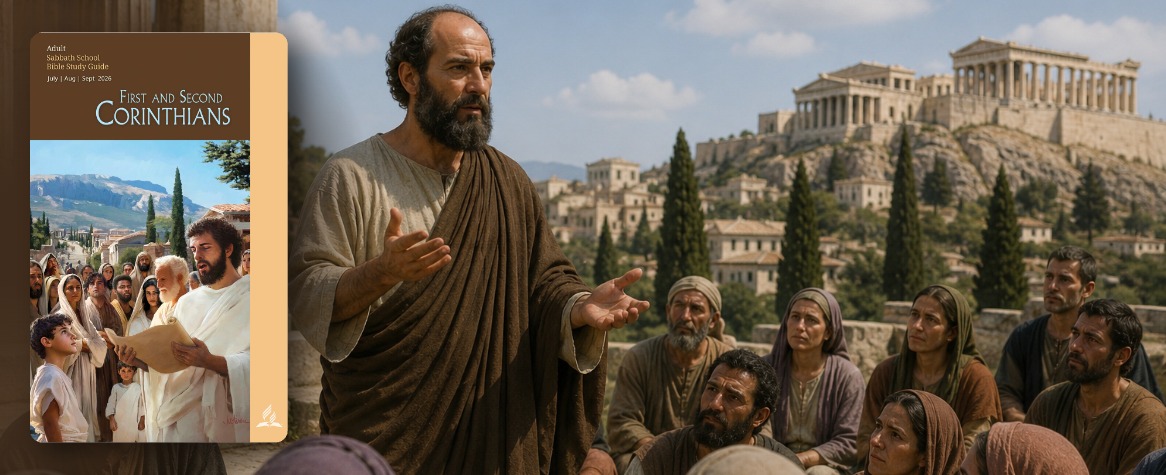
Sabbath Afternoon, July 11
Memory Text
“Now I beseech you, brethren, by the name of our Lord Jesus Christ, that ye all speak the same thing, and that there be no divisions among you; but that ye be perfectly joined together in the same mind and in the same judgment.” KJV — 1 Corinthians 1:10
Remember that “Satan lives, and is active, and every day we need to cry earnestly to God for help and strength to resist him. As long as Satan reigns we shall have self to subdue, besetments to overcome! And there is no stopping place, there is no point to which we can come and say we have fully attained.
“The Christian life is constantly an onward march. Jesus sits as a refiner and purifier of His people; and when His image is perfectly reflected in them, they are perfect and holy, and prepared for translation. A great work is required of the Christian. We are exhorted to cleanse ourselves from all filthiness of the flesh and spirit, perfecting holiness in the fear of God. Here we see where the great labor rests. There is a constant work for the Christian. Every branch in the parent vine must derive life and strength from that vine, in order to yield fruit.” 1T 340.4
It is imperative, therefore, that every Present-truth believer teach and practice only Present Truth--teach not short of nor beyond what is published, weave not into it private interpretations or constructions, theories and ideas, and do nothing less or nothing more than what the message calls for.
Sunday, July 12
The Problem of Cliques in the Church
Read 1 Corinthians 1:12–17. How does this passage help us understand how absurd it is to form cliques around local leaders? What is Paul’s solution?
“In the early Christian church there were some who refused to recognize either Paul or Apollos, but held that Peter was their leader. They affirmed that Peter had been most intimate with Christ when the Master was upon the earth, while Paul had been a persecutor of the believers. Their views and feelings were bound about by prejudice. They did not show the liberality, the generosity, the tenderness, which reveals that Christ is abiding in the heart. AA 279.3
“There was danger that this party spirit would result in great evil to the Christian church, and Paul was instructed by the Lord to utter words of earnest admonition and solemn protest. Of those who were saying, “I am of Paul; and I of Apollos; and I of Cephas; and I of Christ,” the apostle inquired, “Is Christ divided? was Paul crucified for you? or were ye baptized in the name of Paul?” “Let no man glory in men,” he pleaded. “For all things are yours; whether Paul, or Apollos, or Cephas, or the world, or life, or death, or things present, or things to come; all are yours; and ye are Christ’s; and Christ is God’s.” 1 Corinthians 1:12, 13; 3:21-23. AA 280.1
“Paul and Apollos were in perfect harmony. The latter was disappointed and grieved because of the dissension in the church at Corinth; he took no advantage of the preference shown to himself, nor did he encourage it, but hastily left the field of strife. When Paul afterward urged him to revisit Corinth, he declined and did not again labor there until long afterward when the church had reached a better spiritual state.” AA 280.2
Read Romans 1:29, Romans 13:13, 1 Corinthians 3:3, 2 Corinthians 12:20, and Galatians 5:20. What other sins are listed along with eris (“contention,” “strife”)? What does this tell us about how bad it is?
“In this letter Paul endeavored to show the Corinthians Christ’s power to keep them from evil. To help them break from the thralldom of sin, Paul urged the claim of Him to whom they had dedicated their lives: “You are not your own; you were bought with a price. So glorify God in your body.” TT 163.2
“Paul begged them to control the lower passions and appetites. He aroused their better nature and inspired them to strive for a higher life. He knew that at every step in the Christian pathway the Corinthian believers would be opposed by Satan and that they would have to engage in conflicts daily. They would have to force back old habits and natural inclinations, ever watching unto prayer. But Paul knew also that in Christ crucified they were offered power sufficient to enable them to resist all temptations to evil. TT 163.3
“The Corinthian believers had seen but the first rays of the early dawn of God’s glory. Paul’s desire for them was that they might follow on to know Him whose going forth is prepared as the morning, and learn of Him until they should come into the full noontide of a perfect gospel faith.” TT 163.4
Monday, July 13
Centered on Jesus
Read 1 Corinthians 1:10. What do you think Paul meant by “be united in the same mind and the same judgment” (ESV)?
“Strive earnestly for unity. Pray for it, work for it. It will bring spiritual health, elevation of thought, nobility of character, heavenly-mindedness, enabling you to overcome selfishness and evil surmisings, and to be more than conquerors through Him that loved you and gave Himself for you. Crucify self; esteem others better than yourselves. Thus you will be brought into oneness with Christ. Before the heavenly universe, and before the church and the world, you will bear unmistakable evidence that you are God’s sons and daughters. God will be glorified in the example that you set. 9T 188.1
“The world needs to see worked out before it the miracle that binds the hearts of God’s people together in Christian love. It needs to see the Lord’s people sitting together in heavenly places in Christ. Will you not give in your lives an evidence of what the truth of God can do for those who love and serve Him? God knows what you can be. He knows what divine grace can do for you if you will be partakers of the divine nature.” 9T 188.2
“‘I beseech you, brethren, by the name of our Lord Jesus Christ, that ye all speak the same thing, and that there be no divisions among you; but that ye be perfectly joined together in the same mind and in the same judgment.’ 5T 236.1
“Union is strength; division is weakness. When those who believe present truth are united, they exert a telling influence. Satan well understands this. Never was he more determined than now to make of none effect the truth of God by causing bitterness and dissension among the Lord’s people.” 5T 236.2
Tuesday, July 14
Wisdom and Maturity
Read 1 Corinthians 3:1–4. How does Paul here describe the spiritual immaturity of the Corinthians?
“During the year and a half that Paul had spent in Corinth, he had purposely presented the gospel in its simplicity. “Not with excellency of speech or of wisdom” had he come to the Corinthians; but with fear and trembling, and “in demonstration of the Spirit and of power,” had he declared “the testimony of God,” that their “faith should not stand in the wisdom of men, but in the power of God.” 1 Corinthians 2:1, 4, 5. AA 270.3
“Paul had necessarily adapted his manner of teaching to the condition of the church. “I, brethren could not speak unto you as unto spiritual,” he afterward explained to them, “but as unto carnal, even as unto babes in Christ. I have fed you with milk, and not with meat: for hitherto ye were not able to bear it, neither yet now are ye able.” 1 Corinthians 3:1, 2. Many of the Corinthian believers had been slow to learn the lessons that he was endeavoring to teach them. Their advancement in spiritual knowledge had not been proportionate to their privileges and opportunities. When they should have been far advanced in Christian experience, and able to comprehend and to practice the deeper truths of the word, they were standing where the disciples stood when Christ said to them, “I have yet many things to say unto you, but ye cannot bear them now.” John 16:12. Jealousy, evil surmising, and accusation had closed the hearts of many of the Corinthian believers against the full working of the Holy Spirit, which “searcheth all things, yea, the deep things of God.” 1 Corinthians 2:10. However wise they might be in worldly knowledge, they were but babes in the knowledge of Christ. AA 271.1
“It had been Paul’s work to instruct the Corinthian converts in the rudiments, the very alphabet, of the Christian faith. He had been obliged to instruct them as those who were ignorant of the operations of divine power upon the heart. At that time they were unable to comprehend the mysteries of salvation; for “the natural man receiveth not the things of the Spirit of God: for they are foolishness unto him: neither can he know them, because they are spiritually discerned.” Verse 14. Paul had endeavored to sow the seed, which others must water. Those who followed him must carry forward the work from the point where he had left it, giving spiritual light and knowledge in due season, as the church was able to bear it.” AA 271.2
Wednesday, July 15
Christlike Servanthood
Read 1 Corinthians 4:1, 2. What does this passage teach about the correct view one must have about human leaders?
“‘It is required in stewards, that a man be found faithful.’ 1 Corinthians 4:2. If honesty is an essential principle of business life, must we not recognize our obligation to God—the obligation that underlies every other? Ed 139.1
“By the terms of our stewardship we are placed under obligation, not only to God, but to man. To the infinite love of the Redeemer every human being is indebted for the gifts of life. Food and raiment and shelter, body and mind and soul—all are the purchase of His blood. And by the obligation of gratitude and service thus imposed, Christ has bound us to our fellow men. He bids us, “By love serve one another.” Galatians 5:13. “Inasmuch as ye have done it unto one of the least of these My brethren, ye have done it unto Me.” Matthew 25:40. Ed 139.2
“‘I am debtor,’ Paul declares, ‘both to the Greeks, and to the barbarians; both to the wise, and to the unwise.’ Romans 1:14. So also are we. By all that has blessed our life above others, we are placed under obligation to every human being whom we might benefit. Ed 139.3
“These truths are not for the closet more than for the counting room. The goods that we handle are not our own, and never can this fact safely be lost sight of. We are but stewards, and on the discharge of our obligation to God and man depend both the welfare of our fellow beings and our own destiny for this life and for the life to come.” Ed 139.4
Read Philippians 2:5–8. How does this text help us understand the phrase “the mind of Christ” (1 Cor. 2:16)?
“In consenting to become man, Christ manifested a humility that is the marvel of the heavenly intelligences. The act of consenting to be a man would be no humiliation were it not for the fact of Christ's exalted pre-existence. We must open our understanding to realize that Christ laid aside His royal robe, His kingly crown, His high command, and clothed His divinity with humanity, that He might meet man where he was, and bring to the human family moral power to become the sons and daughters of God. To redeem man, Christ became obedient unto death, even the death of the cross.” 1SM 243.
“The psalmist says, “The entrance of Thy words giveth light; it giveth understanding unto the simple” (Psalm 119:130). When truth is working only upon the conscience, it creates much uneasiness; but when truth is invited into the heart, the whole being is brought into captivity to Jesus Christ. Even the thoughts are captured, for the mind of Christ works where the will is submitted to the will of God. “Let this mind be in you, which was also in Christ Jesus” (Philippians 2:5). He whom the Lord makes free is free indeed, and he cannot be brought into servile bondage to sin.—Manuscript 67, 1894.” 1MCP 324.3
Thursday, July 16
A lifestyle that reflects the Cross
Read 2 Corinthians 11:23–28 and Colossians 1:24. What does this teach us about what it means to suffer for Christ’s sake?
“These histories are of vital interest. To none are they of deeper importance than to the youth. Moses renounced a prospective kingdom, Paul the advantages of wealth and honor among his people, for a life of burden bearing in God's service. To many the life of these men appears one of renunciation and sacrifice. Was it really so? Moses counted the reproach of Christ greater riches than the treasures in Egypt. He counted it so because it was so. Paul declared: “What things were gain to me, these have I counted loss for Christ. Yea verily, and I count all things to be loss for the excellency of the knowledge of Christ Jesus my Lord: for whom I suffered the loss of all things, and do count them but refuse, that I may gain Christ.” Philippians 3:7, 8, R.V., margin. He was satisfied with his choice. Ed 68.3
“Paul also in his manifold labors was upheld by the sustaining power of His presence. “I can do all things,” he said, “through Christ which strengtheneth me.” “Who shall separate us from the love of Christ? shall tribulation, or distress, or persecution, or famine, or nakedness, or peril, or sword? ... Nay, in all these things we are more than conquerors through Him that loved us. For I am persuaded, that neither death, nor life, nor angels, nor principalities, nor powers, nor things present, nor things to come, nor height, nor depth, nor any other created thing (Rotherham's translation), shall be able to separate us from the love of God, which is in Christ Jesus our Lord.” Philippians 4:13; Romans 8:35-39. Ed 69.3
“Yet there is a future joy to which Paul looked forward as the recompense of his labors—the same joy for the sake of which Christ endured the cross and despised the shame—the joy of seeing the fruition of his work. “What is our hope, or joy, or crown of rejoicing?” he wrote to the Thessalonian converts. “Are not even ye in the presence of our Lord Jesus Christ at His coming? For ye are our glory and joy.” 1 Thessalonians 2:19, 20. Ed 70.1
“Who can measure the results to the world of Paul's lifework? Of all those beneficent influences that alleviate suffering, that comfort sorrow, that restrain evil, that uplift life from the selfish and the sensual, and glorify it with the hope of immortality, how much is due to the labors of Paul and his fellow workers, as with the gospel of the Son of God they made their unnoticed journey from Asia to the shores of Europe? Ed 70.2
“What is it worth to any life to have been God's instrument in setting in motion such influences of blessing? What will it be worth in eternity to witness the results of such a lifework?” Ed 70.3
Friday, July 17
Further Thought
“Then as the children of God are one in Christ, how does Jesus look upon caste, upon society distinctions, upon the division of man from his fellow man, because of color, race, position, wealth, birth, or attainments? The secret of unity is found in the equality of believers in Christ. The reason for all division, discord, and difference is found in separation from Christ. Christ is the center to which all should be attracted; for the nearer we approach the center, the closer we shall come together in feeling, in sympathy, in love, growing into the character and image of Jesus. With God there is no respect of persons. 1SM 259.2
“Jesus knew the worthlessness of earthly pomp, and He gave no attention to its display. In His dignity of soul, His elevation of character, His nobility of principle, He was far above the vain fashions of the world. Although the prophet describes Him as “despised and rejected of men; a man of sorrows and acquainted with grief” (Isaiah 53:3), He might have been esteemed as the highest among the noble of the earth. The best circles of human society would have courted Him, had He condescended to accept their favor, but He desired not the applause of men, but moved independent of all human influence. Wealth, position, worldly rank in all its varieties and distinctions of human greatness, were all but so many degrees of littleness to Him who had left the honor and glory of heaven, and who possessed no earthly splendor, indulged in no luxury, and displayed no adornment but humility. 1SM 259.3
“The lowly, those bound with poverty, pressed with care, burdened with toil, could find no reason in His life and example which would lead them to think that Jesus was not acquainted with their trials, knew not the pressure of their circumstances, and could not sympathize with them in their want and sorrow. The lowliness of His humble, daily life was in harmony with His lowly birth and circumstances. The Son of the infinite God, the Lord of life and glory, descended in humiliation to the life of the lowliest, that no one might feel himself excluded from His presence. He made Himself accessible to all. He did not select a favored few with whom to associate and ignore all others. It grieves the Spirit of God when conservatism shuts man away from his fellow man, especially when it is found among those who profess to be His children. 1SM 260.1
“Christ came to give to the world an example of what perfect humanity might be when united with divinity. He presented to the world a new phase of greatness in His exhibition of mercy, compassion, and love. He gave to men a new interpretation of God. As head of humanity, He taught men lessons in the science of divine government, whereby He revealed the righteousness of the reconciliation of mercy and justice. The reconciliation of mercy and justice did not involve any compromise with sin, or ignore any claim of justice; but by giving to each divine attribute its ordained place, mercy could be exercised in the punishment of sinful, impenitent man without destroying its clemency or forfeiting its compassionate character, and justice could be exercised in forgiving the repenting transgressor without violating its integrity.” 1SM 260.2